How Restaurants and Cafés Use AI to Handle Reservation Requests During Peak Hours
Drowning in booking calls during the dinner rush? Here's how AI takes over so your team doesn't have to.
 · 8 min read

Estimated reading time: 7 minutes
Key Takeaways

- Missed calls during peak hours are one of the most common — and most avoidable — sources of lost revenue for restaurants and cafés.
- AI reservation assistants can handle booking requests 24/7 across phone, WhatsApp, Instagram DMs and your website chat — without adding headcount.
- The setup is simpler than most owners expect: connect your existing booking tool, train the AI on your hours and rules, and let it manage the conversation flow.
- Staff keep full visibility and control — the AI handles the routine requests, and humans step in only for exceptions.
- The goal is not to replace your front-of-house team but to remove the repetitive interruptions that slow them down during service.
Table of Contents

- The Problem: Why Peak Hours Break Your Booking Process
- How Restaurants and Cafés Use AI to Handle Reservation Requests
- Which Channels the AI Covers — and How
- What a Practical Setup Looks Like
- What AI Cannot Do (and Where Humans Stay in Charge)
The Problem: Why Peak Hours Break Your Booking Process

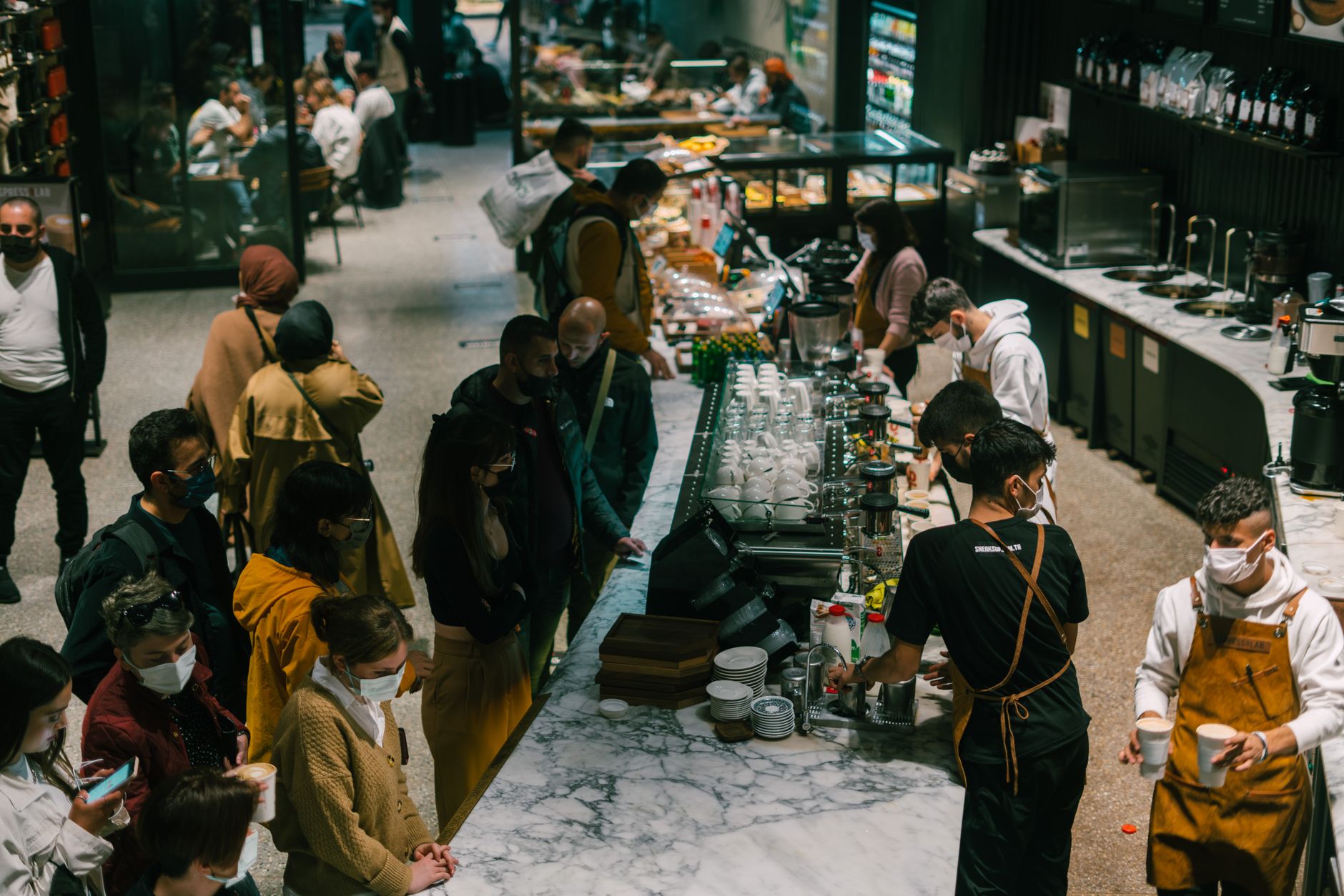
Friday evening, 7:30 PM. Your dining room is full, your team is in the weeds, and your phone is ringing. Nobody picks up. A customer who wanted to book a table for Saturday night hangs up after four rings and opens a competitor's website instead. This happens every service, at every busy restaurant. Calls go unanswered, messages get replies three hours late, and potential customers simply book elsewhere. You never even know how many you lost.
The economic cost is real. A missed booking for a table of four at €40 per head is €160 in revenue that never happened — and you didn't even know you lost it. Multiply that by three or four missed calls per service, four services a week, and the number becomes significant quickly.
The good news is that this is one of the most automatable problems in the hospitality industry. Reservation requests follow predictable patterns. Customers ask the same questions: "Do you have availability this Saturday at 8 PM? Is the terrace open? Can you do a birthday table?" An AI assistant can handle all of that — consistently, instantly, and without adding a single person to your payroll.
How Restaurants and Cafés Use AI to Handle Reservation Requests

Definition — AI reservation assistant: An AI reservation assistant is a software system that uses natural language processing to understand incoming booking requests across text and voice channels, qualify the details (date, time, party size, special requirements), check availability in real time, and confirm or reschedule bookings — all without human intervention for standard requests.
In practice, here is what happens when a customer sends a message to your restaurant on WhatsApp at 8 PM on a Saturday:
- The AI receives the message immediately — no wait, no queue.
- It understands the intent: the customer wants to book a table.
- It asks the qualifying questions: date, time, number of guests, any dietary needs or special requests.
- It checks your booking system in real time for availability.
- If a slot is open, it confirms the booking, sends a confirmation message, and logs the reservation in your system.
- If no slot is available, it offers the nearest alternatives — and gives the customer the option to join a waiting list or choose a different date.
The entire exchange takes under two minutes. Your team didn't touch it. The customer got a response while your staff were in the middle of service. And the booking is in your system, correctly, with all the details.
This is not science fiction. Tools like GHL (GoHighLevel), Tidio, or custom GPT-based assistants connected to booking platforms like Resy, SevenRooms, or even a simple Google Calendar can do this today, without requiring a development team.
Which Channels the AI Covers — and How
One of the most common mistakes restaurant owners make when thinking about AI is imagining it only works on one channel — usually a website chatbot. In reality, a properly configured AI reservation assistant can operate across every channel your customers already use to reach you.
WhatsApp and Instagram DMs
These are the two dominant channels for reservation requests in most markets right now. Customers message you the way they message friends — they expect a fast reply. An AI connected to your WhatsApp Business account or Instagram inbox responds immediately, 24 hours a day, even at 11 PM when someone is planning next weekend's dinner.
Website chat widget
A chat bubble on your website is still highly effective, especially when your Google listing drives traffic. Someone searching for a restaurant on a quiet Tuesday evening lands on your page — the chat widget opens automatically and starts the booking conversation before they even scroll down.
Phone (voice AI)
Voice AI is more complex to set up but increasingly viable. A voice assistant answers your restaurant's phone line, speaks naturally, captures the booking details, and either confirms the booking or tells the caller a human will call back for unusual requests. This is particularly useful for the 60-and-over demographic that still prefers to call rather than message.
Less common for quick bookings, but useful for group reservations or event inquiries. An AI can parse incoming emails, extract the relevant details, and send a structured reply — including a link to a booking form for large parties where you need more information before confirming.
What a Practical Setup Looks Like
You do not need a technology team to get this running. Here is a realistic setup for a restaurant with 40 to 80 covers:
Step 1 — Choose your booking backbone
If you already use a booking tool (Resy, TheFork, OpenTable, or even a shared Google Calendar), keep it. The AI layer sits on top of it and reads availability from it. You do not need to replace your existing system.
Step 2 — Define your reservation rules
This is where you invest time upfront. Write down every rule you currently apply mentally: maximum party sizes per slot, lead time required for large groups, which days you accept walk-ins only after 9 PM, what happens when the terrace is closed. The AI needs these rules in plain text so it can apply them correctly.
Step 3 — Build the conversation flow
Map out the standard booking conversation. Most tools allow you to create a simple decision tree: collect date → collect time → collect party size → check availability → confirm or offer alternatives. Keep it short. Five to six messages maximum for a standard booking. Customers on WhatsApp are not reading paragraphs — they want quick, clear replies.
Step 4 — Connect your channels
Connect the AI to your WhatsApp Business account, your Instagram inbox, and your website chat widget. This typically takes a few hours per channel with platforms like GHL or ManyChat. Phone requires additional setup (a SIP number and a voice AI layer) and is worth adding once the text channels are running smoothly.
Step 5 — Test it before going live
Run through twenty scenarios manually: a standard booking, a fully booked date, a group of twelve, a request for a specific table, a customer asking about the menu instead of booking. Fix the edge cases before your customers find them for you.
What AI Cannot Do (and Where Humans Stay in Charge)
Being clear about the limits of AI is as important as understanding what it can do. If you go in with unrealistic expectations, you will be disappointed. If you go in knowing exactly what to automate and what to keep human, you will get results.
Here is what the AI should NOT handle on its own:
- Complex complaints or negative reviews — A customer angry about a past experience needs a human response with genuine empathy. AI can acknowledge the message and flag it for your manager, but it should not attempt to resolve disputes autonomously.
- Large group events and private dining contracts — A birthday party for 30 with a set menu, AV equipment and a deposit involves too many variables for a standard flow. The AI can collect initial details and hand off to a human to finalise.
- Calls requiring local knowledge or judgment — Questions like "Is parking difficult on Saturday nights?" need context and nuance that are better answered by your team.
- Unusual requests — Surprise proposals, guests with severe allergies, accessibility needs — flag these for a human to follow up personally.
The practical rule is this: the AI handles the routine 80% so your team can focus on the 20% that actually requires human judgment. That is not a downgrade for your staff — it is a better use of their time and attention during service.
Conclusion
Running a restaurant or café during a busy service is hard enough without fielding booking calls every ten minutes. The technology to automate routine reservation requests is available today, it connects to the tools you already use, and it does not require a technical background to implement.
The businesses getting the most out of this are not the ones trying to replace their front-of-house team. They are the ones who have figured out exactly which tasks to remove from their team's plate so that the people on the floor can do their actual job — making guests feel welcome and taken care of.
Start with one channel. WhatsApp or your website chat is the fastest win. Get it working reliably for two weeks. Then expand.
Want to go further? Join the Skool group (200+ entrepreneurs) and the AI builders' Discord → Join the community
Running a business and want to automate your content or processes with AI? → Book a call
FAQ
Can an AI handle restaurant reservation requests without any human involvement?
For standard requests — date, time, party size, confirmation — yes, fully. The AI checks availability, confirms the booking and logs it in your system without anyone on your team touching it. Human involvement kicks in only for unusual requests or exceptions you define in advance.
Which booking platforms work with an AI reservation assistant?
Most AI reservation setups connect to tools like Google Calendar, OpenTable, TheFork, Resy, and SevenRooms via API or integration platforms like Zapier or Make. If your current booking tool has an API or a calendar sync, it can almost certainly be connected.
How long does it take to set up an AI reservation system for a restaurant?
For a basic text-based setup covering WhatsApp and your website chat, expect one to two weeks from start to live. That includes defining your reservation rules, building the conversation flow, connecting your booking tool and testing. Voice AI on your phone line typically takes an additional week.
Will an AI reservation assistant replace my front-of-house staff?
No. It removes the repetitive, interruptive tasks — answering booking messages during service, replying to WhatsApp at 11 PM — so your existing team can focus on the guests in the room. Staffing levels for in-person service remain a separate decision.
What happens when a customer asks something the AI cannot handle?
You define escalation rules upfront. Typically, if the AI cannot confidently answer within two or three attempts, it tells the customer that a team member will follow up shortly and flags the conversation for your manager. The customer gets a clear response and your team gets an alert — no message falls through the cracks.
Is an AI reservation assistant expensive to run for a small restaurant?
The cost depends on the platform and channels you use. Many setups run on tools that cost between €50 and €200 per month for a single-location restaurant. Compared to the revenue lost from missed bookings during peak hours, most owners see a positive return within the first month.
On voit si l'IA peut faire cartonner votre business ?
15 minutes, cash. Pas de script, pas de jargon. Au pire, on vous dit que ce serait un flop — et vous aurez gagné du temps.